Since 1 October 2025, every property let short-term in Greece must meet a set of minimum specifications. This is not only about new listings: the law explicitly covers properties already registered in the ΑΑΔΕ registry with an ΑΜΑ number. If your villa or apartment takes bookings through Airbnb, Booking or directly, these requirements apply to it today, and the first on-site inspections have already begun.
The framework is article 3 of Law 5170/2025 (Government Gazette Α΄ 6/20.01.2025), with the implementation details in Ministry of Tourism circular 19231/19.09.2025. Below is what is actually required, how inspections work and what non-compliance costs, based on the texts themselves rather than on what circulates second-hand.
The four statutory requirements
The list in article 3 has exactly four points. First, the property must be a main-use space with natural light, ventilation and air conditioning. Second, it must carry civil liability insurance for damage or accidents. Third, it needs a certified electrician's declaration (ΥΔΕ), fire extinguishers, smoke detectors, an anti-electrocution circuit breaker and escape signage. Fourth, it must hold a pest control certificate, a first-aid kit and a list of emergency phone numbers.
It is worth noting what is not on the list: there is no minimum size and no energy performance certificate. Anything you read about such requirements does not come from this law.
The details that catch owners out
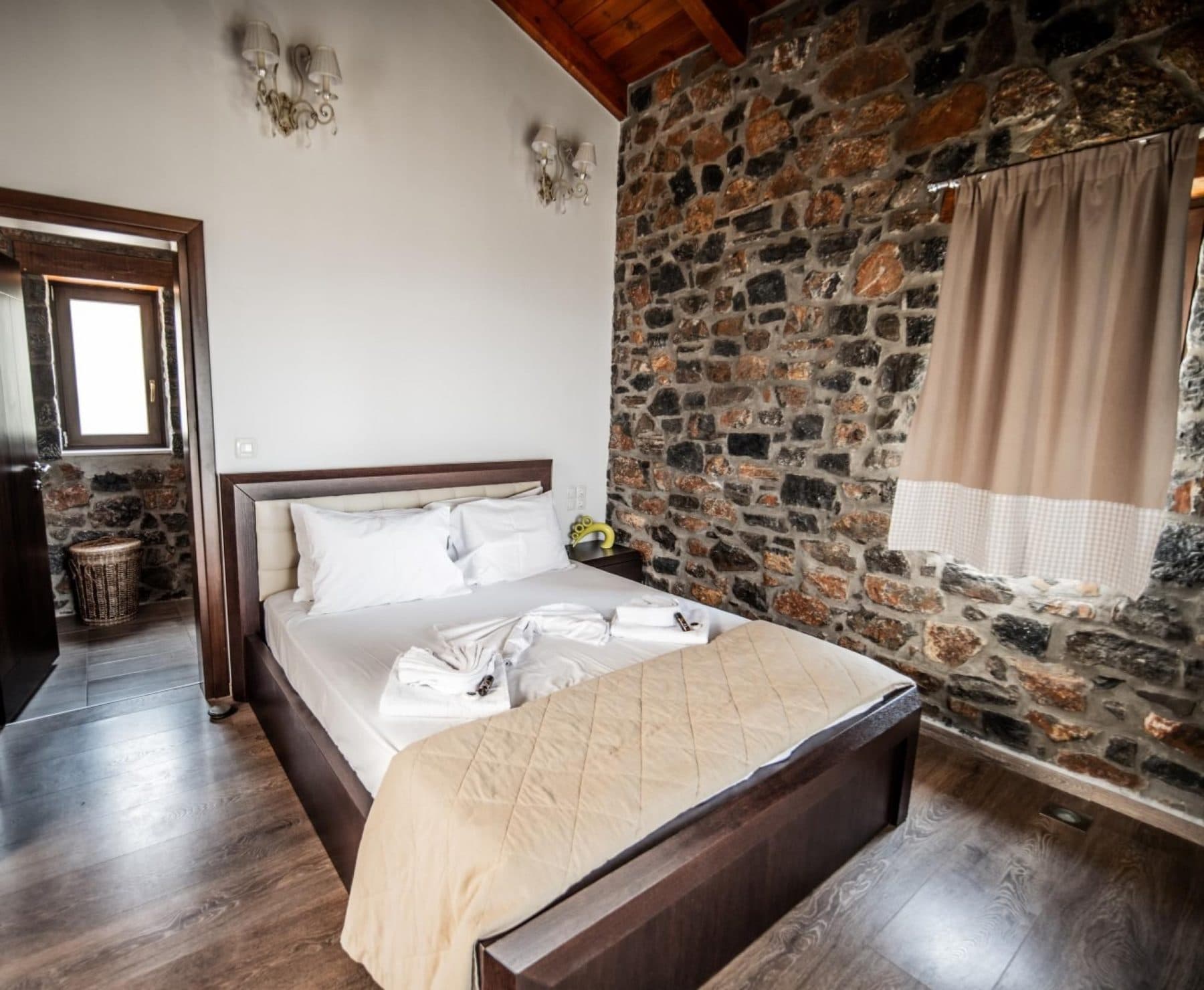
The circular fills in specifics that few owners know. Main use means a free ceiling height of at least 2.50 metres (2.40 for buildings that predate the current building code), with legality shown by the building permit or a formal regularisation. Bedrooms must have natural light through openings of at least 10% of their net floor area and natural ventilation through openings of at least 5%.
- Air conditioning: mandatory in at least the bedrooms, with a cooling and heating unit, fixed or portable. Only properties in mountain areas at 600 metres altitude or above are exempt.
- Fire extinguishers: one portable dry-powder or water-based extinguisher of at least 6 kg per 100 m² of gross area, rated 21A-113B-C.
- Smoke detectors: autonomous, ceiling-mounted, covering at least the bedrooms and the kitchen.
- An emergency light at every exit, plus escape-route signage.
- A current electrician's declaration (ΥΔΕ) certifying the anti-electrocution breaker.
First aid, pest control, emergency numbers
The first-aid kit is not a box with whatever happens to be around. It must carry the bilingual label «ΠΡΩΤΕΣ ΒΟΗΘΕΙΕΣ / FIRST AID KIT» and contain a minimum set of items: hydrogen peroxide, povidone iodine, sterile gauze in several sizes, adhesive tape, an elastic bandage, haemostatic dressings and the further items the circular lists.
The pest control certificate must be current and issued by a licensed company. The emergency numbers list must be available to guests: 112, police, fire brigade, ambulance, the poison centre, the nearest hospital. In the properties we manage, that list lives inside the info book we prepare for every arrival.
Who inspects, and how
Inspection is on site, by Ministry of Tourism officials, and can also be carried out by joint teams with the tax authority, which check tax compliance at the same time. Inspectors must carry service identification and a written inspection order. Press reports from the summer of 2026 describe the first wave of inspections covering roughly 1,500 properties selected from the registry.
The fines
Breach of any specification carries a stand-alone administrative fine of 5,000 euros, imposed on the property manager. The same fine applies if inspectors are refused entry. If a new inspection within a year finds the same breach, the fine doubles to 10,000 euros, and each further repeat quadruples it.
Put plainly: a 30-euro first-aid kit and a 40-euro extinguisher cost a fraction of a percent of the fine they prevent. There is no reason for any property to carry that risk.
Note also who the fine lands on: the property manager, meaning the person shown in the ΑΑΔΕ registry. If you run the property yourself, the manager is you. If a company runs it for you, responsibility for compliance is something the agreement should state explicitly, not something anyone discovers on the day of an inspection.
What to do in practice
- Check whether you hold a current ΥΔΕ and whether it certifies the anti-electrocution breaker. If not, book an electrician.
- Ask your insurer for a civil liability policy for the specific property, from a lawfully licensed insurance company.
- Measure the gross area and buy the right number of extinguishers and detectors.
- Book a licensed pest control visit and file the certificate with the property's documents.
- Stock a first-aid kit with the full minimum contents and print the emergency numbers list.
For the properties we manage, checking this list is part of preparing the property: we identify what is missing and coordinate the electrician, the insurer and the pest control crew, so the property's file is complete before the first booking. The certificates always remain in the owner's name. See what full management covers, and if the property does not yet hold an ΑΜΑ, start with our registration guide.
The specifications apply to every registered property, whenever it was registered. The tax side of short-term letting is covered separately in our [tax guide](/en/blog/short-term-rental-tax-greece-crete).